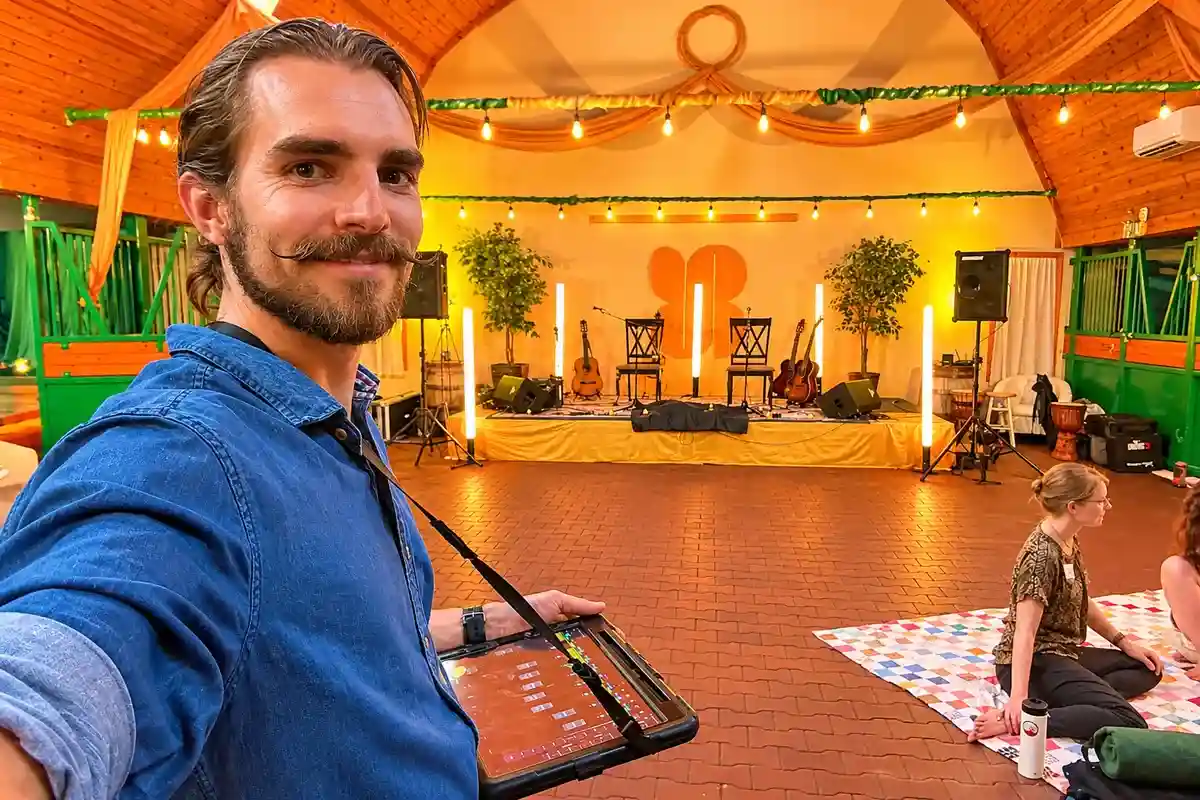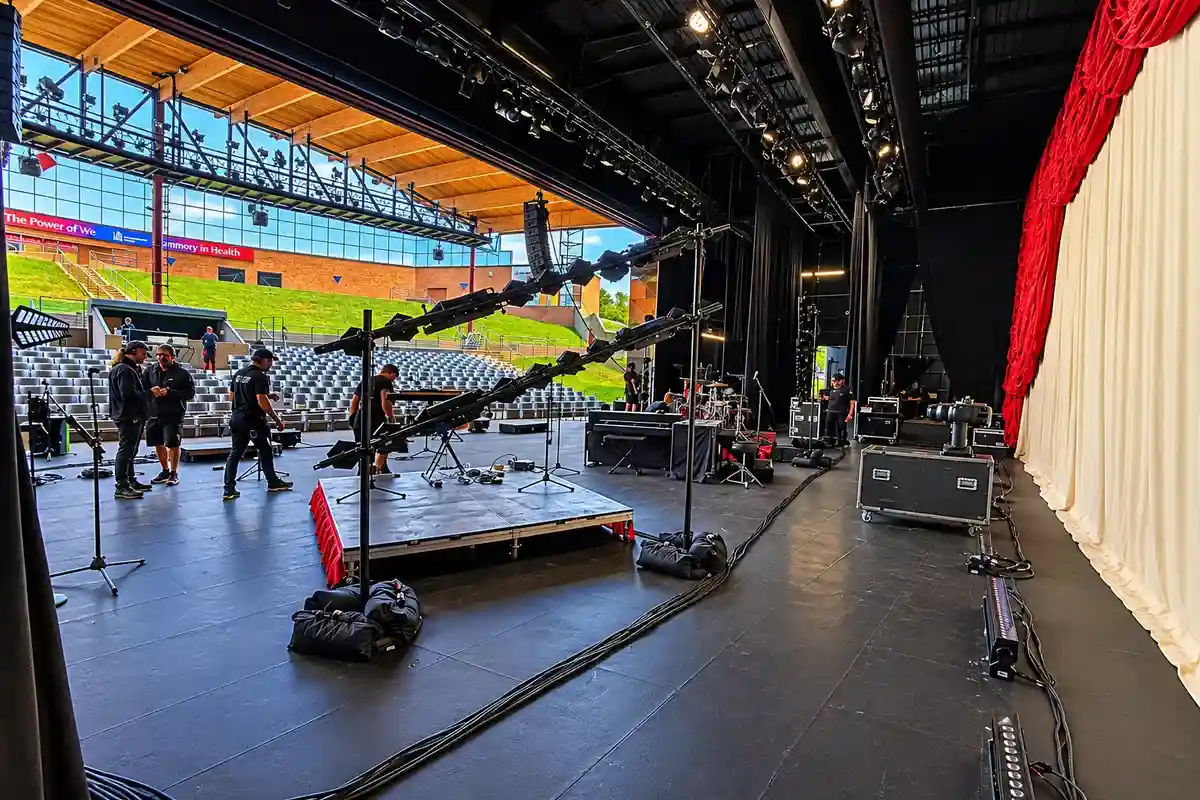
At 11 a.m. on November 11, the crowd at a Front Range memorial goes quiet. The World War I armistice took effect at the eleventh hour of the eleventh day of the eleventh month in 1918, and many ceremonies still pause at that hour. In that silence, a humming speaker or a squealing mic is all anyone hears. When M3DIUM Productions plans a Veterans Day event ceremony sound system, the goal is that every name in the roll call is heard and the silence stays silent. That takes a wired podium mic, one wireless backup, speakers in front of the podium, windscreens outdoors, and an engineer at the board from the first word to the last note.
Quick Facts — Date: November 11 every year – Key moment: 11 a.m. silence – Mics: usually 2-4 – Packages: from $800 – Booking: 1 week minimum – Contact: (720) 893-1933
What a Veterans Day ceremony sound system needs to cover
Three jobs: voices, music, and silence. Voices means the emcee, speakers, and the roll call reaching the back row. Each name read aloud belongs to someone’s parent, grandparent, or friend, and for the family in the crowd it may be the moment they came for.
Music usually means the anthem and Taps. Silence is the easiest part to overlook: a cheap cable can hum, and a nearby generator can drone. That pause belongs to the people being remembered, not to the equipment.
Ceremony microphone setup: how many mics and which kind?
Two to four mics covers most ceremonies.
The podium mic
Use a wired mic on a gooseneck or stand; it can’t drop out and needs no batteries. Outdoors, choose a dynamic mic over a condenser, which picks up more wind.
Wireless mics and a spare
A handheld wireless suits the emcee, singer, or reader of names; a lavalier suits a chaplain who walks. Keep one spare, and load fresh batteries right before the program, since cold drains them faster. A choir or band adds inputs quickly, which is a job for a live sound engineer.
Where should the speakers go?
In front of the podium, angled out toward the crowd, never behind the person talking. A speaker behind the mic sends sound back into it, and that loop is feedback. Around a flagpole or memorial, two speakers on stands at the front corners beat one loud speaker.
Outdoor ceremony sound and Boulder’s November wind
Wind is the biggest outdoor problem, and November is a real risk on the Front Range. A NOAA climatology of Boulder’s damaging downslope windstorms, built from records between 1869 and 1972, found they happened most often in January, with November next. Researchers studying these storms note they often strike with little warning.
Put a windscreen on every mic and weigh down the speaker stands. Boulder’s special events handbook also requires extension cords to be grounded, secured, and covered so nobody trips over them.
| Indoor (gym, hall, auditorium) | Outdoor (park, memorial, plaza) | |
| Main problem | Echo off hard walls | Wind and open space |
| Speakers | Two often cover the room | Wider spread for a scattered crowd |
| Power | Wall outlets | Needs approval or a generator |
| Mic protection | Standard | Windscreen on every mic |
| Weather | No risk | Cold, wind, possible snow |
If the weather turns
Boulder’s park event guidelines include a step one week out to check the forecast and discuss a backup plan or alternate location. The National Weather Service Boulder office also publishes Weather Ready planning tools for outdoor events. Pick an indoor backup room, set a time for the final call, and keep the mixer covered.
Power at parks and memorials
Don’t assume there’s an outlet near the podium. In Boulder city parks, using existing electricity needs written approval from Boulder Parks and Recreation in advance, and not every park has power. The city’s own venue list shows Eben G. Fine Park without electricity.
For permitted events, the city’s handbook requires portable generators to be fenced off from the public, kept at least 10 feet from tents and other combustible materials, and paired with an ABC fire extinguisher. For sound, place the generator as far from the crowd as the cable allows, so it can’t be heard during the silence.
Do you need a permit for amplified sound in Boulder?
Possibly. Inside Boulder city limits, a Special Event Permit is required for planned and promoted public activities on public property that draw 50 or more people or use sound amplification, among other criteria. Private park reservations and events on private property don’t need one.
The city accepts initial applications 364 to 120 days before an event, so a November 11 ceremony needs its application in by mid July. Permitted events must carry general liability insurance, and amplified sound must meet the city’s noise code from setup through teardown, with the organizer responsible for monitoring sound levels throughout. Questions go to the Office of Special Events at specialevents@bouldercolorado.gov. Other Front Range towns, including Louisville, set their own rules, so check with the town hosting the ceremony.
National anthem and Taps
Live singer or recording?
For a live singer, soundcheck their real voice on the handheld before guests arrive. For national anthem playback from a recording, connect the phone or laptop by cable instead of Bluetooth, cue the track before the ceremony starts, and switch the device to airplane mode so no alert interrupts the anthem.
Finding a bugler and placing them
Taps is only 24 notes, and it is often the part of a ceremony people remember most. Bugles Across America, a volunteer nonprofit founded in 2000 with more than 1,500 buglers nationwide, matches requests with buglers within 100 miles of an event, Veterans Day events included, at no cost. Every volunteer must pass an audition, and availability isn’t guaranteed, so request early.
At small and medium outdoor ceremonies, a bugle carries on its own, and speakers can make Taps sound harsh. Place the bugler a short distance from the crowd, and test at soundcheck if the crowd is very large.
Planning sound for veterans with hearing loss
VA research has described hearing problems, including tinnitus, as by far the most common service connected disability among veterans. That means the honored guests in the front rows are often the people who struggle most to hear the tribute meant for them. A ceremony held in their honor should never leave them guessing at the words.
More volume doesn’t fix that; more clarity does. Aim speakers over the first rows, cut the boomy low end, and ask whether the venue has a hearing loop or other assistive listening option.
Soundcheck and the run of show
Confirm the crew’s arrival time in the quote, and finish soundcheck before guests arrive. Test each mic with the person who will use it, and listen from the back row. A rehearsed program lets the people at the podium focus on the veterans in front of them instead of the equipment.
Give the engineer a cue sheet of every audio moment, marked live or recorded, and agree on a hand signal so all music is off well before 11 a.m.
Can a school or post use its own PA instead?
Often yes for a small ceremony, if there’s a wired podium mic, one person at the mixer, an on site test, and a frequency check on wireless mics. The FCC required wireless mics in the 617 to 652 MHz and 663 to 698 MHz ranges to stop operating by July 13, 2020. Spectrum remains available below 608 MHz and in small parts of the 600 MHz band, so check the frequency printed on older receivers.
A 30 person flag raising may not need a hired crew; a few hundred people or a windy site changes that.
Why use one team for sound and video?
For a relative who can’t travel, a stream may be the only way to watch a parent or grandparent honored, and to replay it years later. M3DIUM brings the DJ, sound engineer, gear, and videographer under one roof with one point of contact. That makes it simple to feed the stream audio straight from the sound board, not a camera mic, so viewers hear speeches instead of wind. Its videography covers that side of Veterans Day event AV, including recap films.
Founded by DJ and sound engineer Jordan Groth, M3DIUM has produced more than 600 events over more than 8 years, and holds a 5.0 Google rating from more than 100 reviews. For a slideshow screen, confirm it’s in the quote, since the published gear list centers on audio.
How much does the Veterans Day event sound cost in Boulder?
A basic Veterans Day ceremony sound system starts with M3DIUM’s Essential package at $800, which includes powered speakers, a subwoofer, mics, and a dedicated engineer. Larger programs fit Professional at $1,200 to $3,500, which adds stage monitors. Recording and streaming fall under Conference and Live at $3,000 to $10,000. Gear rental includes delivery and setup, and quotes are custom; see the pricing page.
M3DIUM recommends booking at least one week out, but most ceremonies land on the same date, so reach out early.
Get a sound plan for your ceremony
A Veterans Day ceremony asks one thing of its sound: that every name is heard and the silence holds. Send M3DIUM the date, start time, venue, crowd size, and program order through the booking page or hello@m3diumproductions.com, noting a live or recorded anthem, any bugler or choir, and where power is. A custom quote typically arrives within 24 hours, or call Jordan at the number above.
Frequently Asked Questions
Two powered speakers on stands, a wired podium mic, a wireless handheld, a spare, a mixer, and someone to run it. Outdoors, add windscreens and a power plan.
Traditionally 11 a.m., the hour the World War I armistice took effect in 1918. Congress made November 11 a legal holiday in 1938 and renamed it Veterans Day in 1954.
It can. Boulder requires a Special Event Permit for planned public events on public property with 50 or more people or amplified sound. Private park reservations are exempt.
Bugles Across America takes requests through its website and connects them with volunteer buglers nearby at no cost. Availability isn’t guaranteed, so request early.
Not if it operates in the 617 to 652 MHz or 663 to 698 MHz ranges. The FCC required those mics to stop operating by July 13, 2020.
Yes. Conference and Live includes recording and streaming, with audio from the sound board.
Yes. It covers the Front Range, from Fort Collins to Colorado Springs.